Astrological Aspects Explained: What Conjunctions, Sextiles, Squares, Trines, and Oppositions Mean in Your Birth Chart
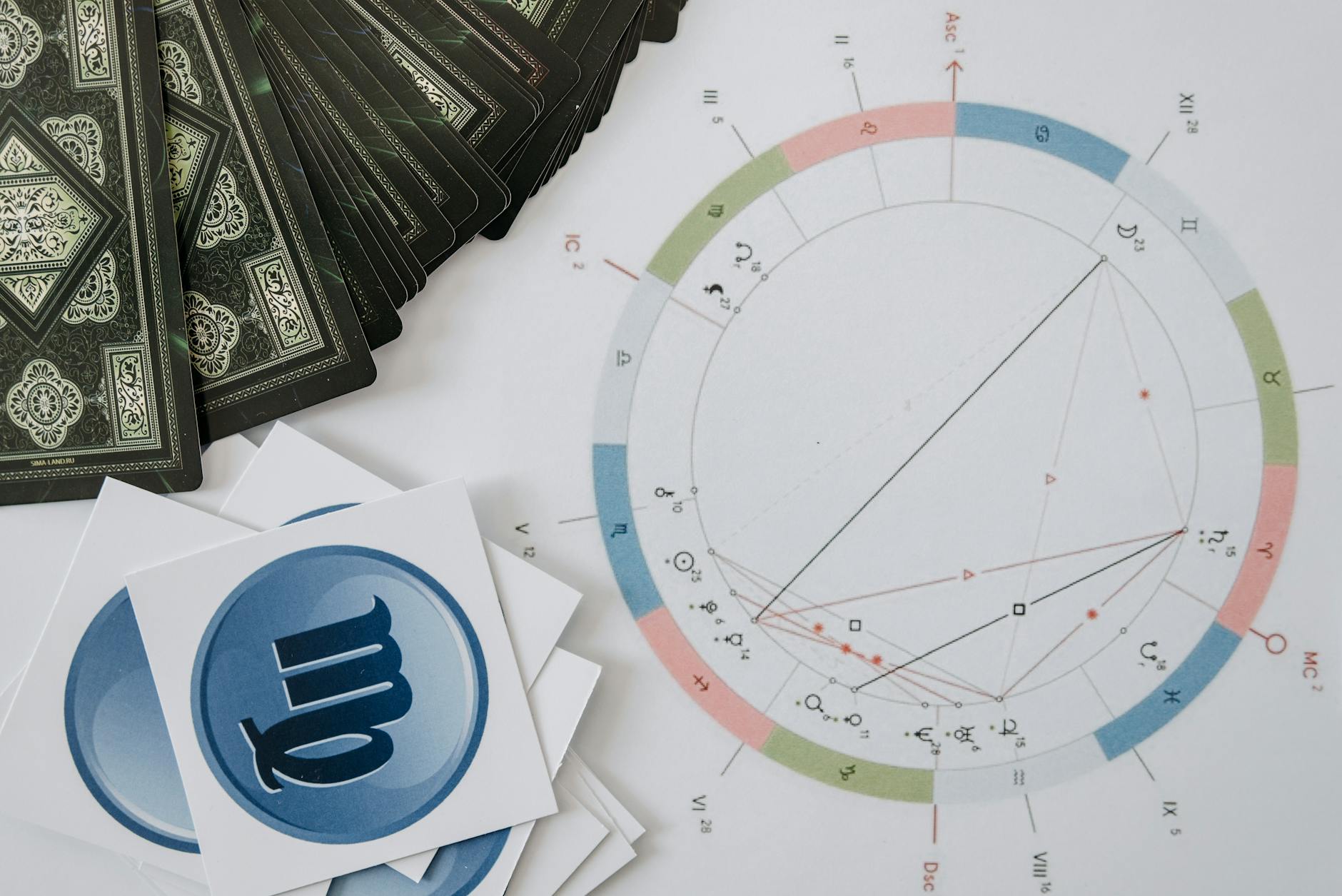
You can know your sun sign, moon sign, and rising sign and still feel like your birth chart is a list of disconnected ingredients. That's because the part that makes a chart actually read like a person isn't the planets themselves — it's the angles between them. Astrologers call these angles aspects, and they describe whether the different parts of you cooperate, ignore each other, or are locked in a permanent argument.
If you've ever wondered why two people with the same sun sign feel nothing alike, the answer is almost always aspects. Two Geminis can both have curious minds, but one has Mercury sextile Jupiter — open, generous, optimistic thinking — while the other has Mercury square Saturn and second-guesses every sentence before it leaves their mouth. The sign is the same. The conversation between the planets is not.
This guide walks you through the five major aspects every reader needs to know, what they actually feel like in real life, and how to spot them in your own chart without paying anyone for a reading.
What Is an Aspect, Really?
An aspect is the angular distance between two planets measured in degrees of the 360-degree zodiac wheel. Astrologers only treat certain angles as meaningful — the ones that correspond to dividing the circle into clean fractions. Divide 360 by 2 and you get the opposition (180°). Divide by 3 and you get the trine (120°). Divide by 4 and you get the square (90°). Divide by 6 and you get the sextile (60°). And when two planets sit on top of each other at 0°, that's a conjunction.
Aspects don't have to be mathematically perfect to count. Most astrologers give each aspect an orb — a few degrees of slack on either side. A conjunction with a 3° orb is still a conjunction. A square that's off by 8° is probably too wide to matter much. The closer the orb, the louder the aspect speaks.
One important thing to understand before going further: aspects aren't "good" or "bad" in a moral sense. The labels you might see online — "harmonious" for trines and sextiles, "challenging" for squares and oppositions — describe how the energy feels, not whether it's serving you. The hardest aspects in your chart are often the ones that built the strongest parts of your personality. The easiest ones are sometimes the talents you take for granted and never develop.
The Conjunction (0°): Fusion
A conjunction happens when two planets occupy the same degree of the same sign. They blend so completely that you can't tell where one ends and the other begins. If Venus and Mars are conjunct in your chart, your love life and your sex drive don't operate on separate tracks — they fire together. If the moon is conjunct Saturn, your emotional life and your sense of duty are fused, often in ways that feel heavy until you learn to work with it.
Conjunctions amplify. Whatever house the conjunction sits in becomes a major area of life. Whatever signs are involved get expressed through both planets at once. Two planets conjunct in Aries will charge into whatever they touch. The same two planets conjunct in Pisces will dream into it.
The personality of a conjunction depends entirely on which planets are involved. Sun conjunct Jupiter is famously lucky and expansive. Mars conjunct Pluto is intense and unstoppable when motivated. Mercury conjunct Neptune produces poetic, intuitive thinkers who sometimes struggle with practical detail. There's no template — there's only the specific combination.
The Sextile (60°): The Open Door
A sextile is two planets sitting 60 degrees apart, which usually means they're in compatible elements — fire and air, or earth and water. The energy between them is friendly and creative, but unlike a trine, it requires you to actually do something to activate it.
Think of a sextile as an opportunity that's been left unlocked. The door is open, but you still have to walk through it. People with Mercury sextile Uranus have the wiring for original, inventive thinking, but they have to choose to use it instead of defaulting to conventional answers. Sun sextile Saturn gives you the capacity for steady, disciplined effort — but only if you decide to apply it.
Sextiles are often where your underdeveloped talents live. They feel less obvious than trines because they don't run on autopilot, but they're more rewarding to work with precisely because they respond to effort. If you want to find the skills you've been quietly underestimating, look at your sextiles.
The Square (90°): The Productive Tension
Squares get a bad reputation they don't fully deserve. Yes, they're tense. Yes, they create internal conflict. But the friction of a square is also what produces growth, ambition, and the drive to actually finish things. A chart with no squares often belongs to someone who never quite gets around to using their gifts.
A square forms between two planets that are 90 degrees apart, usually in signs of the same modality but different elements — fire and earth, water and air, and so on. The two planets want incompatible things, and they don't share a language for negotiating. So they fight. Sun square Moon, for example, means your conscious will and your emotional needs are constantly pulling in different directions. You want to be ambitious, your inner world wants rest. You want stability, your emotions want change.
The work of a square is integration. You can't make one planet win — both will keep showing up no matter what. What you can do is build a third option that honors both. Mars square Saturn isn't doomed to be a frustrated, blocked life. With time, it can become disciplined power. Mercury square Pluto isn't doomed to obsessive overthinking. It can become deep, investigative insight.
Squares mature. The ones that feel unbearable at twenty-two often become the source of your professional edge by thirty-five. The trick is to stop trying to resolve them and start using the energy.
The Trine (120°): The Free Lunch
A trine connects two planets 120 degrees apart, almost always in the same element. The energy flows so easily between them that you barely notice it. Things just work. People with Sun trine Jupiter wake up basically optimistic. People with Venus trine Neptune fall into beautiful, dreamy relationships without trying very hard. Mercury trine Saturn produces minds that are naturally structured and patient.
The problem with trines is exactly that ease. Because the gift is automatic, you don't develop it consciously. A trine is talent you didn't earn — which means you can spend a whole life sitting on top of it without ever building anything with it. Many of the most successful people in any field have a major trine they built into a career on purpose. Many people with the same trine never noticed it.
If you want to know what comes easily to you, read your trines. If you want to know why you sometimes feel like you're coasting on potential you haven't cashed in, also read your trines.
The Opposition (180°): The Mirror
An opposition puts two planets directly across the chart from each other, 180 degrees apart, in opposite signs. Where the square fights, the opposition mirrors. You see one half of the polarity in yourself — and the other half keeps showing up in other people, in your relationships, in the projects that frustrate you.
Sun opposite Moon, the signature aspect of anyone born under a full moon, is a classic example. Your daytime self and your inner emotional life feel like two separate people. You spend the first half of life identified with one and projecting the other onto everyone you date, work with, or fight with. The second half is about pulling them both back inside.
Venus opposite Mars shows up as attraction to people who feel like your opposite — and a recurring discovery that you contain more of their qualities than you wanted to admit. Mercury opposite Jupiter is the tension between the careful, detailed thinker and the big-picture believer; either side alone is incomplete.
The work of an opposition is awareness. Once you notice that you've been outsourcing half of yourself to the people around you, you can take it back. Oppositions tend to feel intense in early relationships and become easier with self-knowledge.
The Minor Aspects Worth Knowing
The five aspects above are the major ones, and they'll explain most of what's happening in any chart. But three minor aspects come up often enough to be worth recognizing.
The quincunx, also called the inconjunct, is 150 degrees. It connects two planets in signs that share nothing — no element, no modality, no obvious bridge. The energy doesn't fight (like a square) and doesn't mirror (like an opposition); it just keeps awkwardly adjusting. Quincunxes are often where chronic, low-grade frustration lives. The two planets need each other but can't quite communicate.
The semi-sextile at 30 degrees connects two planets in neighboring signs. The energy feels close but slightly off-key — like a sibling relationship where you mostly understand each other but occasionally hit a frequency the other one can't hear.
The semi-square at 45 degrees is half a square — smaller scale, similar friction. It tends to create small irritations and minor blockages rather than the major tension of a full square.
How to Find Your Aspects Without a Calculator
You don't need a paid app or a professional reading to spot your major aspects. Pull up any free birth chart calculator — astro.com is the longtime standard — and look at the aspect grid below your chart. Most calculators color-code the aspects: red for squares and oppositions, blue for trines and sextiles, often green or yellow for conjunctions.
Start by finding the aspects that involve your sun, moon, Mercury, Venus, and Mars. These are the personal planets, and aspects between them shape your day-to-day personality more than aspects to the outer planets. Then look at the orb. Aspects within 3 degrees are the ones you'll feel most clearly. Aspects pushing 7 or 8 degrees of orb are real but subtler.
Don't try to read every aspect at once. Pick one — say, your Moon's tightest aspect — and sit with it. Ask yourself whether that description matches your inner emotional life. Then move to the next one. A chart reveals itself in layers, not in a single download.
Aspects in Transit: The Sky Is Always Talking to Your Chart
Aspects don't only exist between the planets in your birth chart. They also form between the planets moving across the sky right now and the fixed positions in your chart. These are called transits, and they're the mechanism behind everything astrologers say is coming up for you this month, this year, or during a major life chapter.
When transiting Saturn forms a square to your natal sun, you go through one of those years where everything seems to demand more discipline and seriousness than you signed up for. When transiting Jupiter trines your natal Venus, opportunities for love, art, and pleasure tend to flow easily for several months. The aspects are the language; transits are the conversation the sky is having with you in real time.
The Pattern That Holds It All
Once you start reading aspects, the chart stops being a list of placements and starts being a story. Your sun in Capricorn isn't just "ambitious" — it's ambitious in tension with your moon in Aries, which wants instant action, and supported by your Mercury sextile Saturn, which thinks in long arcs. Suddenly you understand why your motivation runs hot and cold, why you can plan brilliantly but burn out trying to execute, why patience and impulse keep wrestling inside you.
That's what aspects do. They're the wiring diagram. The planets and signs tell you the components; the aspects tell you how the current flows. Once you can read that, your chart stops being mystifying and starts being a tool — one that quietly explains a lot of the patterns you've been living with your whole life without a name for them.
Want your free daily reading?
Start free